
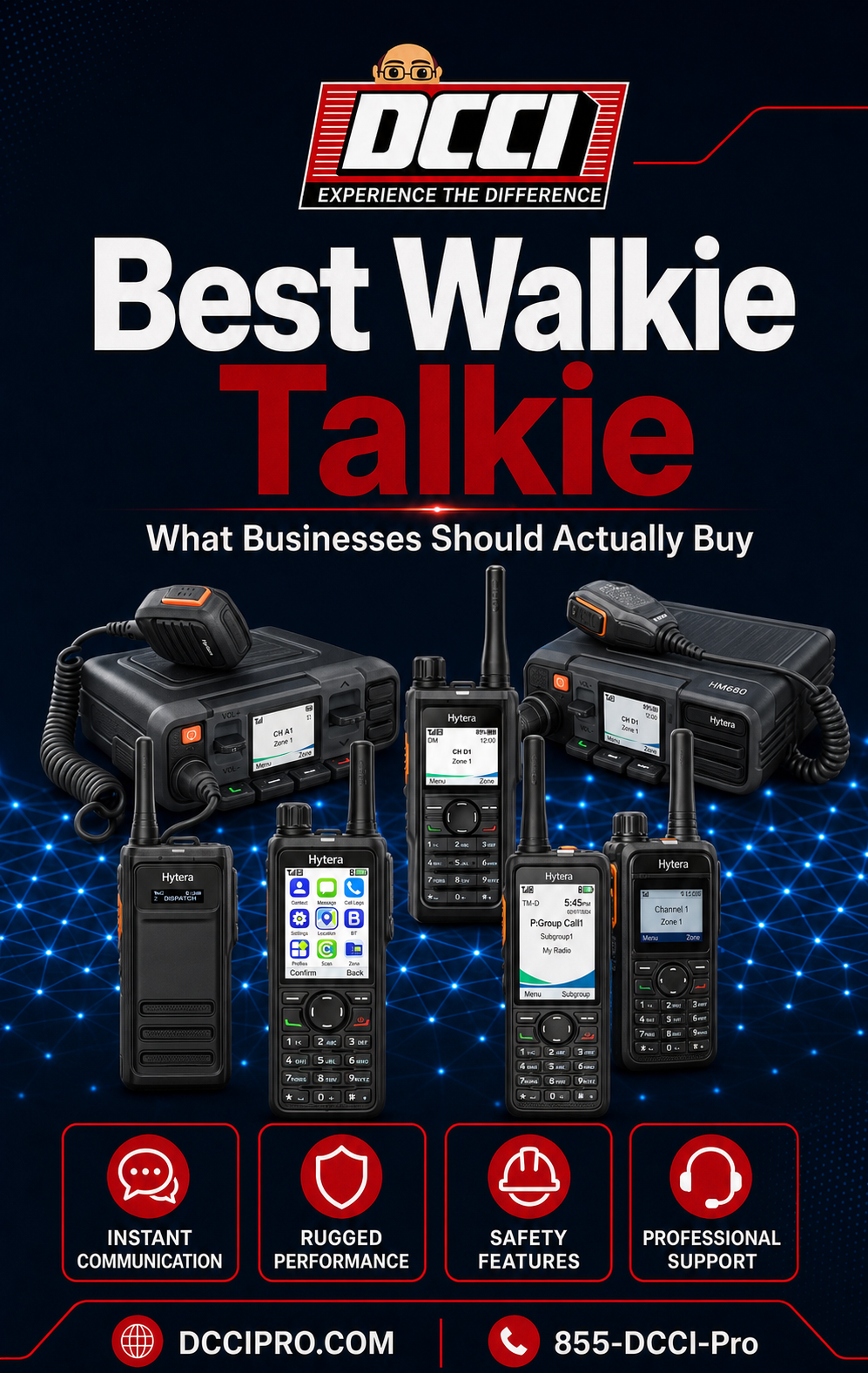
How to Choose the Right Walkie-Talkie for Your Business

Quick Summary
- LMR vs. PoC: Choose Land Mobile Radio (LMR) for single-site operations like factories. Choose Push-to-Talk over Cellular (PoC) for fleets that travel regionally or nationwide.
- Enterprise vs. Consumer: Avoid "bubble-pack" retail radios. Enterprise radios offer dedicated frequencies, high wattage, AI noise cancellation, and rugged durability.
- Safety & Dispatch: Look for built-in GPS tracking, text messaging, and "SOS/Man Down" features integrated into cloud-based dispatch software.
- Budgeting (OpEx): Consider "Radio as a Service" to pay one flat monthly fee that covers hardware, connectivity, repairs, and preventative maintenance with zero surprises.
If you manage a business—whether you run a local towing company, a busy school campus, or a large manufacturing plant—communication is the lifeblood of your operation. When communication breaks down, productivity stops.
At DCCI, we’ve been helping businesses in Central Alabama build enterprise-grade communication systems since 1994. Often, business owners come to us after making the mistake of buying cheap, consumer-grade walkie-talkies.
Here is exactly how to choose the right two-way radio for your business, the features you actually need, and how to avoid wasting money on the wrong equipment.
Stop Buying Toys for Your Business
The most common mistake business owners make is walking into a big-box sporting goods or electronics store to buy "bubble-pack" walkie-talkies.
When you buy a license-free radio off a retail shelf, you are buying a product that works on limited power with a limited number of shared frequencies. In a densely populated area, you will likely hear other people talking on your channel. Furthermore, these radios usually run on AA or AAA batteries and simply aren’t built for the daily abuse of a commercial environment.
A true enterprise two-way radio operates on up to four watts of power with a dedicated frequency that belongs to your business alone. Manufacturers design these radios knowing you want to make this purchase once, not over and over again.
Land Mobile Radio (LMR) vs. Push-to-Talk Over Cellular (PoC)
How do you know what kind of system you need? We evaluate clients based on geography.
If your team works in a single, defined location—like a retail store, a restaurant, or a massive factory warehouse—where employees never leave the premises, a traditional Land Mobile Radio (LMR) or Trunking system is usually the best fit.
However, if your business requires employees to travel—like a towing company out in the field needing to reach a central dispatcher—Push-to-Talk over Cellular (PoC) is the ideal solution. PoC utilizes cellular networks to give you coverage across the city, the state, or even the country.
Match the Durability to the Environment
We always look at the worst-case scenario for your specific environment.
First responders require radios that can handle extreme heat, freezing cold, heavy moisture, and dust. Automotive plant workers operate in harsh, fast-paced environments, meaning they will physically press the Push-to-Talk button much harder to get their message through quickly.
Conversely, a school environment is usually climate-controlled. While the radios are used frequently, they won't face the same physical abuse as a construction site. By matching the ruggedness of the radio to your environment, you avoid overpaying for unnecessary armor or underpaying for something that will break in a week.
Clear Audio Through the Chaos
The most important aspect of any radio is the clarity and consistency of the communication.
In loud environments, our top-tier radios utilize AI technology to filter out background noise, ensuring your message comes through loud and clear every single time the button is pressed.
Accessories are equally critical. A security professional needs lightweight, hidden, high-definition audio earpieces, while a factory worker needs a rugged, heavy-duty speaker microphone to complement their radio.
Built-In Safety: A Lifeline in the Field
In a world where businesses are doing more with fewer resources, features like "Man Down" and "Lone Worker" are imperative.
With fewer eyes on employees, you need a way for them to report back safely. We deploy radios with dedicated SOS features that provide priority communication and instantly share the radio’s GPS location.
For example, if a school bus driver encounters a hostile situation, they can press the SOS button to alert the dispatcher. The dispatcher can then ask for a status check. If the driver responds with a predetermined code phrase—like, "I need you to check my blinker fluid"—the dispatcher instantly knows there is a problem and can roll emergency services directly to the bus's GPS location.
The Digital Advantage: Range, Battery, and Scalability
If you are still using older analog radios, moving to a modern digital radio (like the Hytera BD502i or HP602) provides massive upgrades.
Digital radios offer better range, significantly improved audio quality, and battery life designed to last a full 16-hour shift. But the biggest advantage is scalability. Digital technology allows us to tailor a system exactly to an organization's size—whether that is an auto manufacturer with a thousand radios on 75 different talk groups, or a church with 20 radios covering a 5-acre campus.
Cloud-Based Dispatch and Text Messaging
A modern radio system is controlled by cloud-based dispatch software, giving managers total visibility.
In a factory setting, if a manager isn’t answering their phone, a dispatcher can use the tracking software to see that their radio is sitting in the administration conference room.
Dispatchers can also send short text messages directly to the screen of the radio. A tow company dispatcher can send a message reading, "Another call waiting." This lets the driver know to wrap up their current job and call in, without interrupting them with voice traffic while they are actively working a scene.
The Ultimate Combo: Radios and Telematics
We migrate many of our two-way radio customers over to our ClearPath GPS telematics solutions because business owners prefer a single point of contact.
When you combine cloud dispatch with vehicle telematics, the visibility is incredible. Imagine a scenario where a tow truck is hit in a parking lot. A fleet manager receives an alert. They pull up the live dash-cam video and see the crash, but they notice the driver isn't inside the truck. Because the driver is carrying a PoC radio, the dispatcher can look at the radio’s GPS tracking, see the driver is safely inside a nearby building, and radio them immediately to alert them of the crash outside. The video telematics tells the story, and the radio connects the team.
At DCCI, we even pull video footage for our clients directly—usually within the hour—so they don't have to navigate complex software in an emergency.
Budgeting: CapEx vs. Radio as a Service (OpEx)
Radio systems require an investment, but businesses no longer have to save up massive chunks of capital to buy hardware upfront.
Many organizations are choosing our "Radio as a Service" (OpEx) model. For one low monthly fee per device, you receive the hardware, the software licensing, and the cellular connectivity. More importantly, DCCI manages the radios on your behalf. Warranty claims, repairs, preventative maintenance, and technology upgrades are all built into that single monthly cost. There are no surprises, ever.
For businesses that prefer to own their equipment outright, we offer a CapEx model where you purchase the hardware and pay a low ongoing subscription fee for the software and connectivity.
The Bottom Line
Large, Fortune 500 organizations use these communication tools to scale and grow their operations every single day.
At DCCI, we take those exact same enterprise-level tools and put them in the hands of local small businesses, schools, and security teams across Central Alabama. We don't just sell a product—we integrate multiple business communication resources to ensure your business runs efficiently, safely, and with the exact accountability you need to make critical decisions.
Stop relying on consumer toys and outdated systems.
Contact DCCI today to build a communication network tailored exactly to your business.