
What Is Push-to-Talk Over Cellular (PoC) and How Does It Work?

Quick Summary
- What it is: A two-way radio system that uses cellular networks (AT&T) and Wi-Fi instead of expensive private radio towers.
- The hardware: Rugged, traditional enterprise radios (not fragile smartphones) with single-button use, GPS, and USB-C charging.
- The benefits: Nationwide coverage without dead zones, cloud-based fleet dispatch tracking, and massive cost savings.
- Cost model: Available as an all-inclusive monthly subscription (Radio as a Service) or an upfront hardware purchase with low monthly access fees.
If you run a business that relies on a fleet—whether you’re dispatching tow trucks, coordinating aggregate haulers, or managing school transportation—communication is the backbone of your operation. For decades, traditional Land Mobile Radios (LMR) were the only reliable option.
But over the last few years, a massive shift has occurred. Push-to-Talk over Cellular (PoC) has entered the landscape, offering a revolutionary way to communicate. At DCCI, we’ve helped countless organizations modernize their communications. In fact, our deep expertise and dedication to this technology earned us a national award last year as the Top PoC Radio Producer for Hytera nationwide.
Here is a breakdown of what PoC is, how it works, and why it might be the smartest investment you can make for your fleet.
What is Push-to-Talk Over Cellular?
At its core, PoC is a two-way radio communication system that uses the internet to talk back to a server, providing group communications to users anywhere in the world. Because it is web-based, the infrastructure relies on existing cellular networks or Wi-Fi rather than expensive private radio towers.
It’s a game-changer because you can have users talking across a factory floor or across the entire United States, and all you pay for is the device and the monthly service.
Enterprise Hardware, Not Fragile Phones
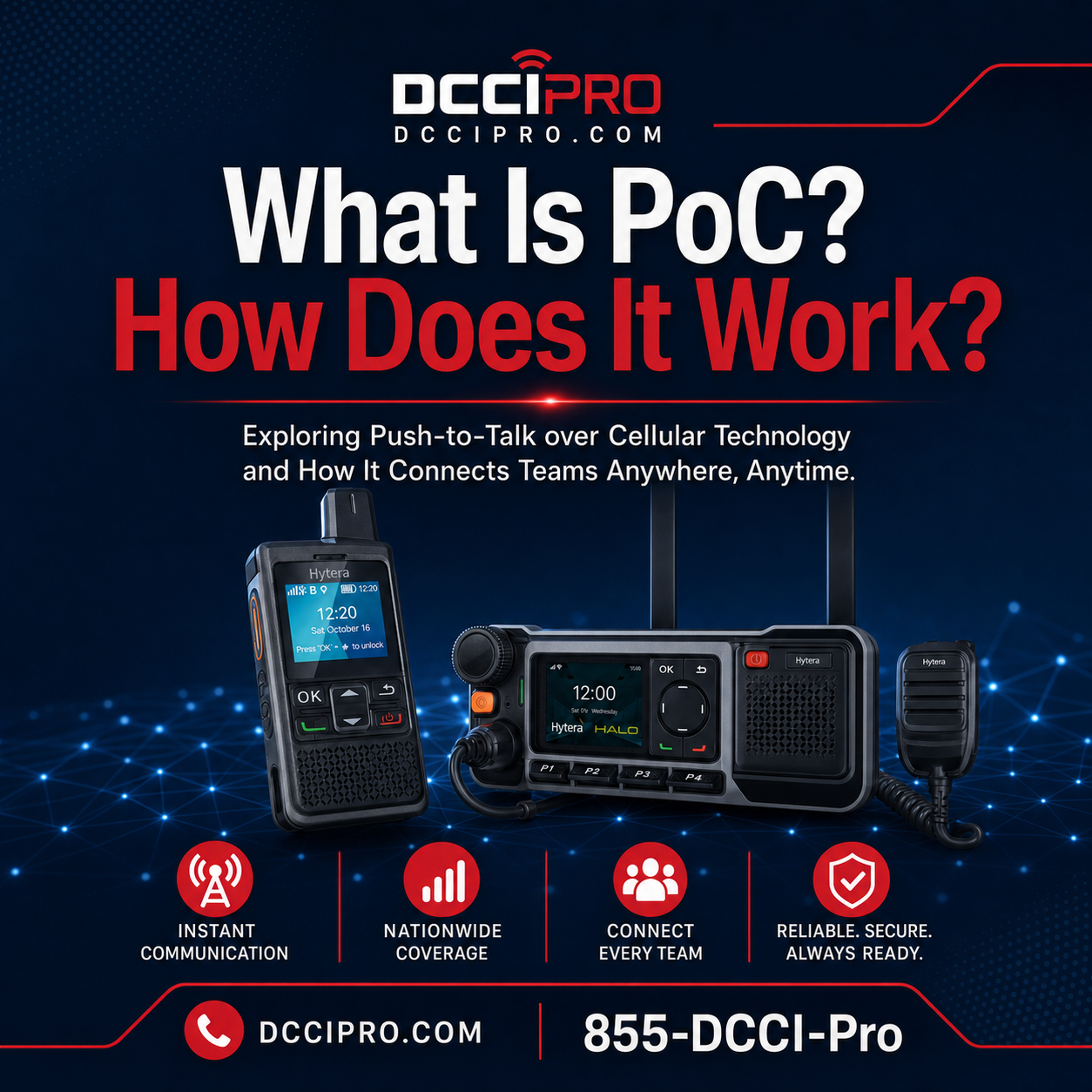
When you hear "cellular," you might picture drivers fumbling with fragile glass-screened smartphones. That’s not the case. Our PoC devices are equipped with GPS, Wi-Fi failover, and Bluetooth, but they maintain a traditional two-way radio form factor.
This means your team gets a high-quality, rugged radio designed for enterprise use on encrypted, secured networks. They limit access strictly to your team and remain invisible to anyone outside your network. Customers are usually surprised by how advanced yet simple they are—most even use a standard USB-C charger rather than proprietary charging docks. And because they are modeled after traditional radios with very few buttons, the learning curve is practically zero.
The Ultimate Coverage: No More Dead Zones
A major concern for fleet managers transitioning to PoC is coverage, particularly in rural areas. However, PoC radios were engineered specifically with wireless data in mind.
At DCCI, our devices operate on the AT&T wireless network, the largest data network in the United States, giving you incredibly reliable coverage. Furthermore, PoC allows for Wi-Fi failover. You can use building Wi-Fi where cellular is weak, or even satellite Wi-Fi to extend your range. For fleets that travel extensively, we offer a tri-carrier SIM at an additional cost to ensure the radio connects to any available cellular tower in the country.
Case Study: Escambia County Schools and AL-Grading
To understand the impact of PoC, it helps to see it in action.
Take Escambia County Schools in South Alabama. We provided their administrators with PoC radios that bridge seamlessly with the traditional LMR radios on their physical campuses. Whether an administrator is on campus or at a conference in another state, they can still communicate with their teams. The central office can monitor all campus traffic, school buses can talk directly to campuses, and every device is tracked via our cloud-based software. It changed the way the campuses and the community communicated immediately.
In the commercial sector, AL-Grading uses our truck-mounted PoC radios to advise each other on traffic conditions and truck locations. Drivers entering and leaving the pit can communicate seamlessly for safety, and dispatch can coordinate time-sensitive loads in real time with all drivers listening at once.
Total Visibility with Cloud-Based Dispatch
With PoC, dispatchers don't need heavy, installed software. Our dispatch console runs right in a Chrome-based browser on a Mac, Chromebook, or PC.
Once logged in, a dispatcher can listen to all talk groups, reach out to users one-by-one, or send text messages to individuals or groups. Crucially, they can track each individual radio. You know exactly whose radio is online, whose is offline, and you can instantly review the location history of the device.
Creating the "Ultimate Bundle" with Telematics
When you pair PoC radios with telematics (like our ClearPath GPS solutions) and dash cameras, you create the ultimate bundle to protect your team.
The radios provide instant communication, while the telematics deliver accountability—verifying that team members are where they should be and providing vital video evidence in the event of an incident.
What makes DCCI different is our service. If you have our radio system and our telematics, you don't call a random 1-800 number after a crash. You call us. We retrieve the video footage and get it to your fleet managers quickly—usually within the hour, if not the same day.
The Financial Advantage: CapEx vs. OpEx (Radio as a Service)
Traditional LMR systems are incredibly expensive. A local towing company with five trucks and ten employees simply cannot afford the $500,000 required to build out towers and repeaters to cover a 100-mile radius. But they can easily afford $40 a month per employee to get that exact same coverage nationwide via PoC.
To make this accessible, DCCI offers two primary financial models:
- OpEx (Radio as a Service): This is our most popular model. For a flat monthly price (like our Freedom Bundles starting at $35/month), you get the radio hardware and unlimited access to the network. You never have to worry about aging technology or replacement costs. If a radio goes out of date, we upgrade it at no charge.
- CapEx (Ownership Model): Designed for organizations that want to own their equipment upfront. You purchase the hardware, and then pay an ongoing monthly subscription (around $24.95) to cover the software licensing and cellular connectivity—just like paying a cell phone bill for the data plan.
The Future of Fleet Communications
Traditional land mobile radios will always have a place, especially where ultimate redundancy and private closed networks are legally required. However, for most small businesses, schools, universities, security companies, and even many first responders, PoC is the clear path forward.
Push-to-Talk over Cellular grants access to a vast, highly reliable infrastructure for a fraction of the cost, completely removing the headaches of FCC licensing, tower leases, and expensive hardware maintenance.
Ready to modernize your fleet's communication with an award-winning national provider?
Contact DCCI today. We handle the onboarding, the training, and the ongoing support so you can focus on running your business.