
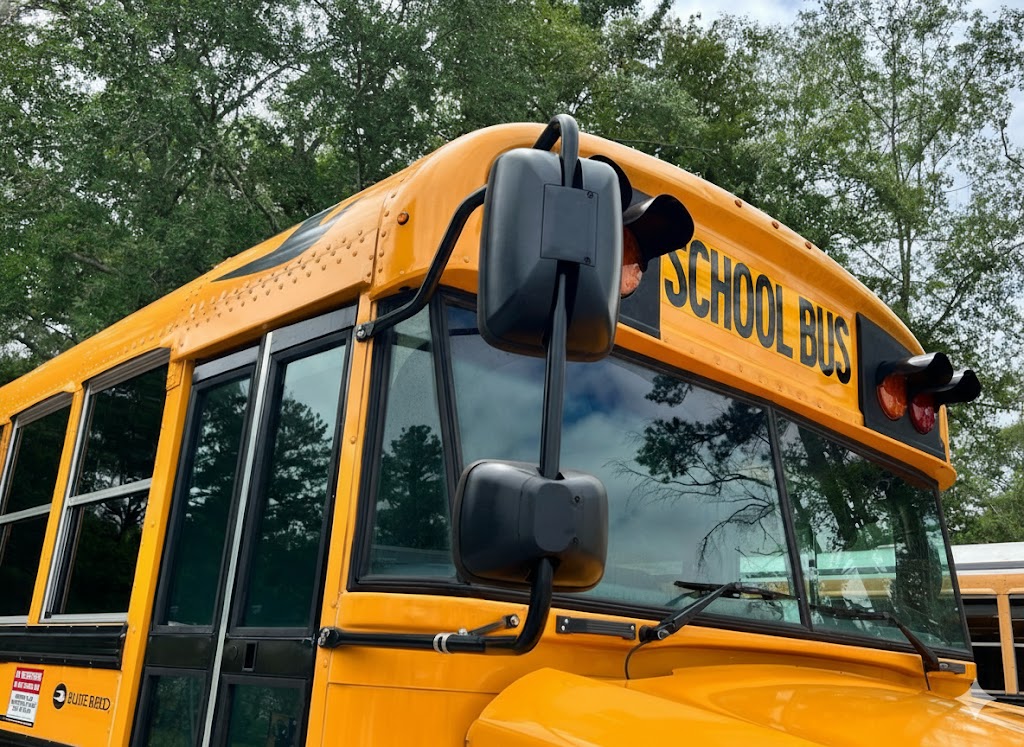
Why Do School Bus Drivers Use Radios? (And Why Your Business Should Too)
Quick Summary
- Single-Button Safety: Alabama school districts require a single-button push to communicate with dispatch during emergencies, which cell phones cannot provide.
- No Dead Zones: Push-to-Talk over Cellular (PoC) utilizes the AT&T wireless network, giving buses and businesses unlimited statewide coverage.
- Zero Distractions: Ruggedized two-way radios have one job—communication. They eliminate the distractions (social media, apps) that come with smartphones.
- Built-in Tracking: PoC radios feature built-in GPS, allowing dispatchers to track the exact location of buses or employees in real-time.
We live in a world where almost everyone has a smartphone in their pocket. Yet, if you look at any school bus fleet operating in Alabama, you won't see drivers texting dispatch or fumbling with mobile apps. You will see dedicated, hardwired two-way radios.
At DCCI, we install and manage communication systems for school districts across the state. The reasons why schools rely on this technology are the exact same reasons why your commercial business—whether you run a plumbing fleet, a towing company, or a construction crew—should be using it too.
The Lifeline of a Single Button
The state of Alabama requires that school districts be able to communicate via two-way radio. Drivers must be able to reach dispatch with a single button push. They are not allowed to use cell phones or any device that connects to the Public Switched Telephone Network (PSTN) while driving.
Think about a driver experiencing a medical emergency, dealing with a fight on the bus, or navigating severe weather conditions. In those critical moments, a driver cannot afford to unlock a screen, open an app, and dial a number. A single-button push is a lifeline. At DCCI, we hardwire these radios directly into the buses. There are no batteries to contend with and no portable devices to lose while driving.
Unlimited Range: Eliminating the "Dead Zone"
Historically, the biggest challenge with traditional two-way radios was range. Buses would hit static or "dead zones" when driving to the edges of the county or taking kids out of district for athletic events. Building private radio repeaters to cover that much land is incredibly expensive.
That is why modern fleets use Push-to-Talk over Cellular (PoC). Because PoC runs on the AT&T wireless network, it provides near-ubiquitous coverage. It is hard to outrun the largest data network in the country. With group calling, a dispatcher can instantly communicate with a bus three towns over, just as clearly as one in the parking lot. If PoC can keep a traveling school bus connected, it can easily keep your commercial service fleet connected across the entire state.
Distraction-Free Operation
Why not just buy a ruggedized smartphone and download a walkie-talkie app? The answer comes down to liability.
Having a dedicated, ruggedized device like a Hytera PoC radio eliminates the need to constantly replace fragile glass screens. More importantly, smart devices introduce massive distractions. When you give an employee a smartphone, you are giving them a portal to social media, games, and internet browsing. A two-way radio’s sole purpose in life is communication. It keeps your personnel focused on the work at hand, safely navigating the roads without the temptation of a touchscreen.
Tracking the Employee, Not Just the Truck
Our radio systems come with GPS tracking built-in for free. While traditional fleet telematics tracks the vehicle itself, a PoC handheld radio tracks the employee. This provides a whole new perspective on accountability. You can know that a truck is parked in the lot, while simultaneously seeing exactly where your employee is located inside a massive warehouse or spread-out job site.
The Ultimate Stress Test for Your Business
When it comes to working with education, there is no room for mistakes. School districts are strategically doing a whole lot more with a lot fewer resources. They rely on their tools to work flawlessly, without question, and with limited servicing required.
At DCCI, we design communication programs for school districts that manage vast areas and fleets traversing thousands of miles in a single day. If they trust us to keep children safe and operations running smoothly, imagine what we can do for your organization. Let us put our expertise in business-critical communications to work for you.
Ready to upgrade your team's communication? Contact us today to learn how Push-to-Talk over Cellular can transform your business.