

Quick Answer
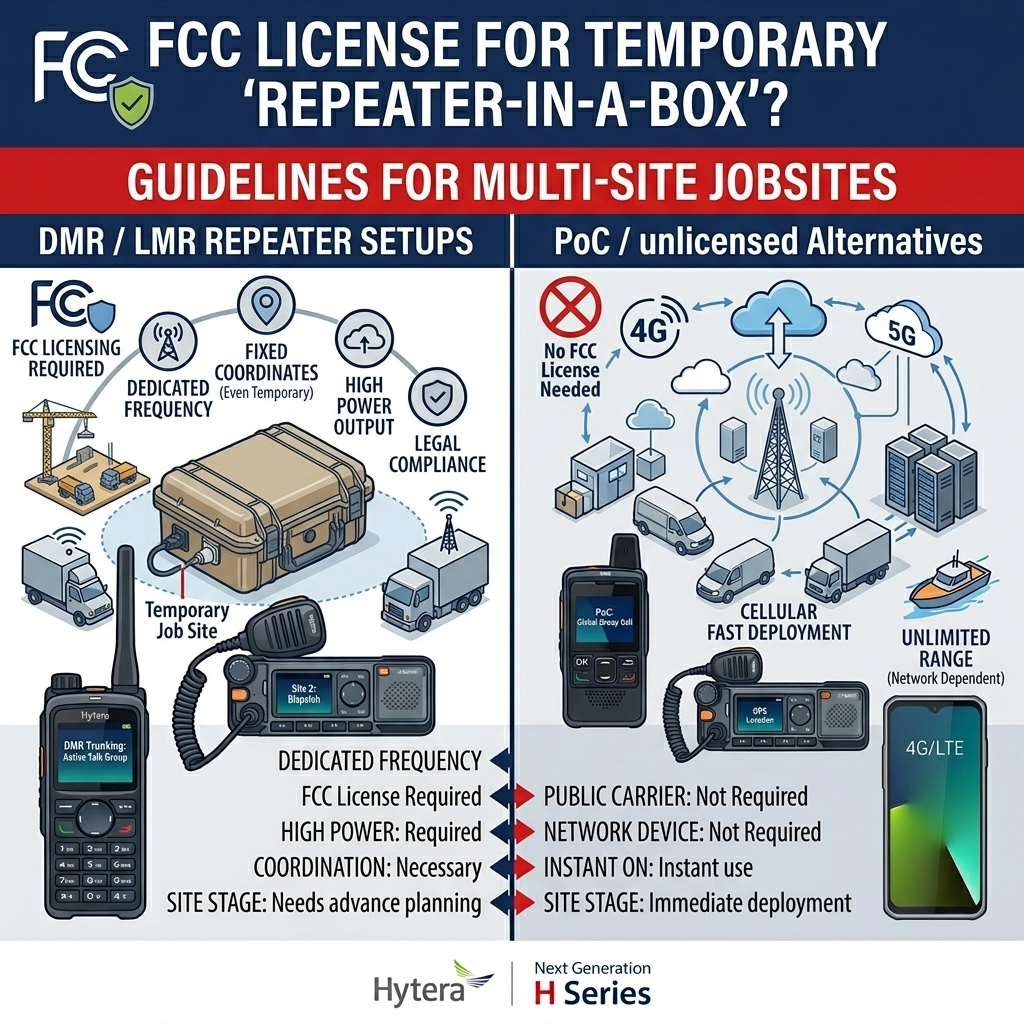
Yes, operating any Land Mobile Radio (LMR) repeater, including a portable "Repeater-in-a-Box" at a temporary job site, requires an FCC license. The standard "itinerant license" meant for temporary radios usually only covers simplex (radio-to-radio) operations, not repeaters. To legally use a portable repeater across different job sites, you must apply for a specific FCC authorization (such as an itinerant duplex license) that covers repeater frequencies and complies with strict power and antenna height limits.
The Convenience of a Repeater-in-a-Box
A "Repeater-in-a-Box" setup is incredibly useful for temporary job sites like major construction zones, large-scale events, or emergency response areas. By taking the signal from a handheld radio and re-transmitting it at a higher wattage, a repeater instantly pushes your communication range past physical obstacles and vast acreage.
Because these units are packaged in rugged, transportable Pelican-style cases, it’s tempting to treat them like standard handheld radios—just turn them on and start talking. However, the Federal Communications Commission (FCC) regulates repeaters very differently than standard walkie-talkies.
Why You Cannot Just Turn It On
All Land Mobile Radios require an FCC license to operate. For mobile teams moving between job sites, the most common solution is an Itinerant License. An itinerant license provides access to shared frequencies nationwide without needing to register a specific geographical location.
However, the catch is that standard itinerant licenses are almost exclusively for simplex operations—meaning direct radio-to-radio communication. They do not allow for the use of base stations, fixed antennas, or repeaters.
FCC Rules for Temporary Repeaters
To use a repeater at a temporary job site, you must hold an FCC license that specifically authorizes repeater (duplex) operations. Because repeaters transmit at higher power levels and can cover massive areas, they are heavily regulated to prevent interference with public safety channels and other businesses.
Operating a temporary repeater comes with strict FCC limitations:
- Frequency Pairs: A repeater requires a specific pair of frequencies (one to receive, one to transmit). You must be licensed for that exact pair.
- Power Restrictions: Temporary base or repeater stations are generally limited to lower power outputs compared to permanent installations (often capped at 6 watts Effective Radiated Power).
- Antenna Height: The FCC limits the antenna height of temporary repeaters to prevent their signal from bleeding into neighboring areas (typically no more than 20 feet above the ground).
The Risks of Operating Unlicensed
Setting up a repeater without the correct license is not worth the risk. The FCC actively tracks down interference, especially when it disrupts emergency services or other licensed operators. The penalties for unauthorized transmission are severe, often involving thousands of dollars in fines, equipment confiscation, and even prosecution.
While the FCC licensing process can seem complicated—requiring an FRN number, specific forms, and sometimes a frequency coordinator—it provides 10 years of legal, secure operations for your business. Working with a professional dealer ensures your application is filed correctly and your equipment is programmed to stay within legal limits.
Need Help with Your FCC Licensing?
Don't risk hefty FCC fines. Contact DCCI today to get your portable repeaters licensed correctly and secure your fleet's communication.